Monday, February 7, 2011

More Lion Dancing

The Chinese New Year celebration usually goes on for two weeks and in many countries it culminates in a huge dragon infested parade. It's no different here in Kuala Lumpur.
Part of the main celebrations surrounding the New Lunar Year are Lion Dances.

There are essentially two types of Lion Dances.
Northern Style, where Lions typically dance using the full body of the lion with jumping and rolling on the floor maneuvers, and Southern Style, where there is more concentration on specific movements of the head and body to show its behavior.

Southern Style is what we see most in Western countries and those associated with Cantonese people. All the pictures here are of Southern Style Lions.

The Origin of the Lion Dance differs depending on what you read and who you listen to.
Many believe it originated with a beast that appeared on New Years to attack and destroy the crops of farmers in the villages. The creature was named "Nien", meaning "year" in Chinese. Gongs and weapons were used to scare it off but it reappeared the following year. Villagers then created an imitation beast with bamboo and colorful paper and used the accompaniment of gongs, drums, and cymbals, to scare it off.

Today, lion dancing is performed on many auspicious occasions such as the dedication of a new building office or store as its believed to bring good fortune and wealth. Its always used during the Chinese Lunar New Year to beckon in a prosperous New Year.

The Southern Lion today is known to be a playful animal with an exaggerated head, huge eyes, and decorated with colorful sequins and lamb or rabbit fur.
Its movements are deliberate and accompanied by specific beats from the drum, gong, and cymbal. Different stances are performed to mimic sleep, waking, drunkenness, happiness, fright, merriment, anger, and suspicion.

Lion Dancing has evolved significantly over the years. Nowhere has is been perfected more in recent years than in Malaysia. There are huge international competitions held yearly in Malaysia and many of the top honors go to the Malaysians. And its not just home street advantage. The huge Chinese population in Malaysia, and particularly in Kuala Lumpur, has nurtured and developed the art of lion dancing beyond the typical.
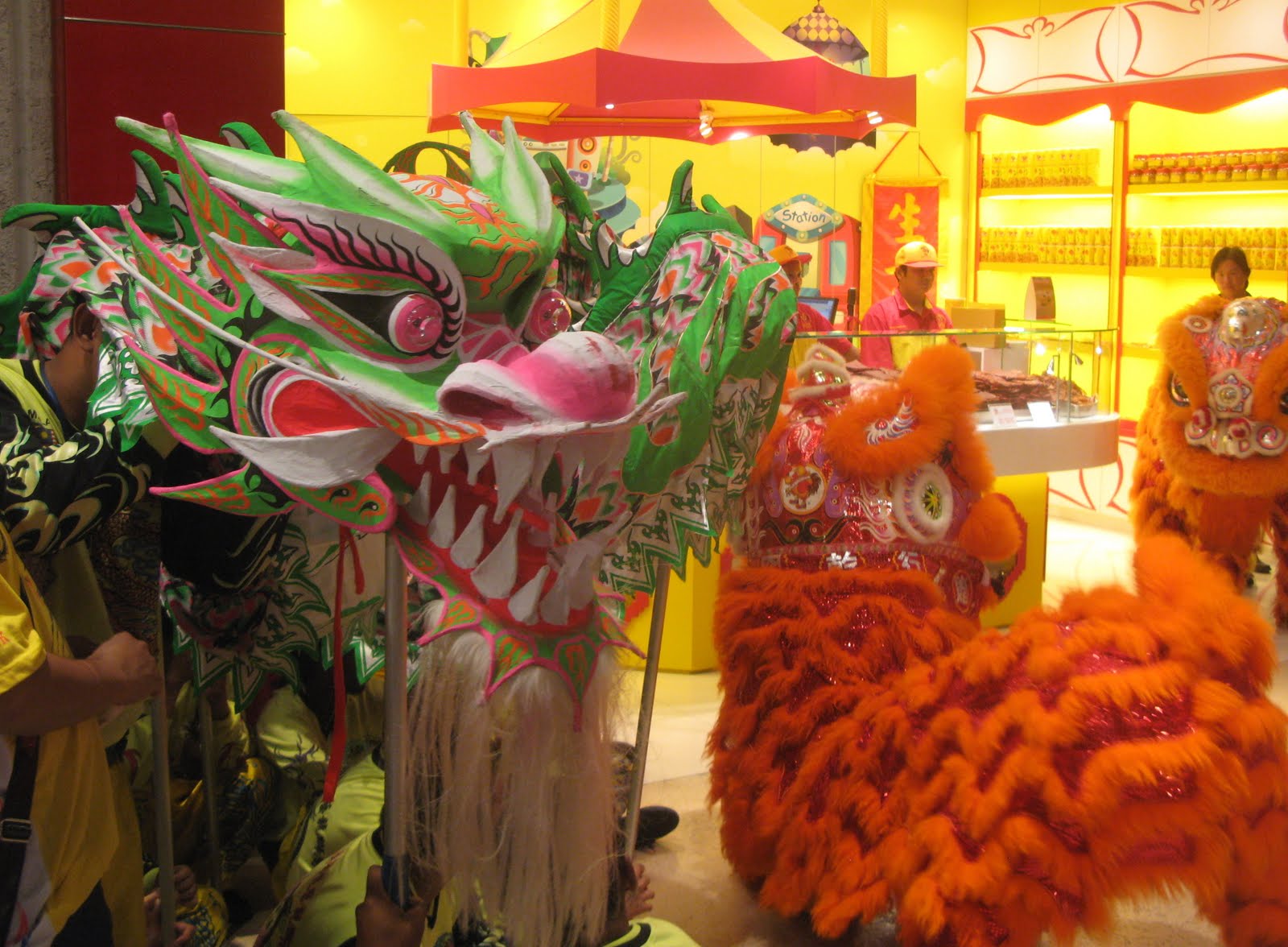
Lion dance troupes are usually associated with martial arts groups, predominately Kung-Fu. In the 1950s and 60s it developed into a gangster-like cult with many of the Kung-Fu studios fighting with with each other. Knives were carried by the lion dancers and street fights materialized when different troupes performed too close to one another. Some acrobatic steps were even developed to kick and attack other lion dancers. Things got so bad in Hong Kong that the authorities had to ban Lion Dancing for a while. Today its highly regulated in Hong Kong and troupes must attain permits to perform.


Give and receive.
Lucky red envelopes are given to lions (through the mouth to the dancer) and in return gifts, such as oranges or a lucky coin, may be given by the lion.

Here are a mess of short lion dancing videos.
Most were taken on the same day at various locations throughout the city of KL.
Sorry about the quality of some of them but for some reason Goog will only allow me to post them at this lower resolution.


Lion Pole Dancing .
A very popular routine here in KL.


The Pavilion Shopping Complex is undoubtedly the flashiest Mall in this city where malls seem to be doubling every every five years.
Lion dancing performances have been happening daily for the last week.


Its easy to see why the Malaysian Lion dancers consistently win competitions.


Lion dancers at one of the Syarikat Makanan Salai Kiew Brothers outlets.
SMSKB is reputed to be the best smoked, dried meat in Kuala Lumpur.
Sometimes referred to as barbequed meat, its a little like jerky only thicker and more tender.
Chicken and Pork are the most popular and their main outlet in Chinatown will usually have long lines at opening time when freshly grill-dried meats are available.

The Lion Dancing at this particular outlet of SMSKB at the Pavilion lasted almost an hour.
Plenty long for a whole mess of good fortune for the New Year.

Thursday, February 3, 2011

Gung Hay Fat Choy KL

Gung Hay Fat Choy from Kuala Lumpur.
It's Chinese New Year and it's certainly celebrated here in Kuala Lumpur where roughly 43% of the 1.8 million people are Chinese.
The Chinese were amongst the earliest immigrants to settle in KL but many came originally to work lower end jobs. Most originated from Guangdong Province and speak Cantonese but Chinese immigrants also migrated from Fujian and Hokkien.
Today, many of the Chinese in KL are English-educated and speak primarily English with some Chinese dialects. A majority of them are involved with the corporate and commercial business sector of Malaysia.


Kuan Ti Temple is one of the two main Chinese Temples in Chinatown.
A Taoist Temple also known as Guan Ti or Kwong Siew Temple, it's dedicated to Kuan Ti, the God of Righteousness.
The temple houses a long knife (Guan Dao) brought from China more than 100 years ago.
Legend has it that anyone who touches the knife will receive its blessings, whatever that means.


Lion pole dancing.


Welcome Year of the Rabbit.
You're a rabbit if you were born on or after the Chinese Lunar New Year in 1915, 1927, 1939, 1951, 1963, 1975, 1987, 1999, or 2011.
Rabbits are generally gentle, calm, loving, and ambitious. They're good listeners, kind, and sweet by nature so they're often sought out as good trusted friends. They also have a good eye for art, design, and fashion (who doesn't know a rabbit thats not a flashy dresser?).
Rabbits are most compatible with Dogs, Sheep, and Pigs (not in this order).


Tuesday, January 18, 2011

Chiang Mai massage


There are probably more places you can get a massage, per square kilometer, in Chiang Mai than anywhere else on the planet. Where throngs congregate, there are bound to be massage chairs set up. No where is this more evident than on the weekends, around the walking markets. And why not? After a couple of hours trudging along narrow congested paths searching desperately for that special item for Aunt Tillie, what would come in handy more than a foot massage?
That's 60 baht for half an hour (about $2.00).

We were introduced to "fish massage" roughly eighteen months ago in some backstreet marketplace in Siem Reap. More an "attraction" than a massage, it's exactly what travelers seek. "... and here I am at the fish massage". "The What?"

You cleanse your feet, soak them in the tank, and while you're surfing away on the internet, small fish pick away at your feet. Doesn't it just send chills up your spine?
How much you say? Three one hundred, I was told. I took that to be 300 baht ($11.00) for a full hour of fish picking fun.

Thai massage, although relatively new to modern day spa menus, evolved over 2500 years ago. First developed by Buddhist monks in Thailand as a healing modality, it's rapidly become a favorite therapeutic and relaxing pastime for tourists and locals alike.
Traditional Thai massage is done on a mat or futon laying on the floor. It involves passive stretching and gentle pressure along the body's energy lines to increase flexibility, as well as relieving joint and muscle tension.

The usual "foot massage" doesn't involve any real pain, even though a rounded wooden peg may be jammed into that most sensitive part of your foot. Oil is often involved and the long slow gentle use of pressure may go up as far as your knee.

There are of course plenty of high end spas offering a full menu of massage delights.
After a two hour, four hands, herbal compress, oil massage, you will indeed be a new person.
Yes, sign me up indeed.

Massage weapons.
The Thai Herbal Compress (Luk Pra Kob) contains up to twenty traditional Thai herbs including Camphor, Kaffir lime, Lemon Grass, Galanga, Tamarind leaves, Prai Ginger Zingiber, Cassumunar, Cinnamon, Turmeric oil, and Aromatic Salisb.

Thursday, January 13, 2011

Chiangmai - what to buy?, what to buy?

Chiangmai, like most other places where tourist congregate, has night bazaars where you can indeed pickup some rather bizarre items.

Coconut animals lights. Why not.

Dog outfits, more for locals but really, who can resist? Once the temperatures get way down into the low 80s, out come the jackets. You wouldn't want your dog to freeze.


Hilltribe merchandise has become very popular with tourists, although I've never actually seen anyone actually making a purchase. We first noticed the pointy hats a couple of years ago and now they're everywhere. OK, on the head of tourists.

The night bazaar in Chiangmai is mostly for tourist. There are an abundance of tourist type items such as t-shirts, luggage, and soap carved into flowers. You don't find many locals shopping here. They can usually get the same items, if they wanted them, somewhere else cheaper. Try down around the Wararoot Market.

Chiangmai also has street markets on the weekends.
Wualai Rd, also known as Silversmith's road, on Saturdays, and Ratchadamnoen Rd., which cuts down the center of the walled city on Sundays. These have become known as the "walking street" markets, although the term crawling street might be more appropriate. The crowds during the high season are unmaneuverable and you just have to inch your way along with everyone else. Not a place for someone who is claustrophobic. But none the less, if you enjoy shopping or looking for "nick-nacks", or some little strange item to take home to friends or family, you'll certainly enjoy being out and about soaking in the people and scenery.

String lights. Yes, a shameless way to get your attention.

The weekend walking streets do have a higher percentage of locals shopping along with all the tourists, and the selection of items offered do reflect it.

OK, who doesn't need pillowcases?

So you may as well shop and buy while you're traveling to Chiangmai. Otherwise you'll regret not having bought that item you bargained so desperately for and ended up not purchasing.

Tuesday, January 4, 2011

Chiangmai lights

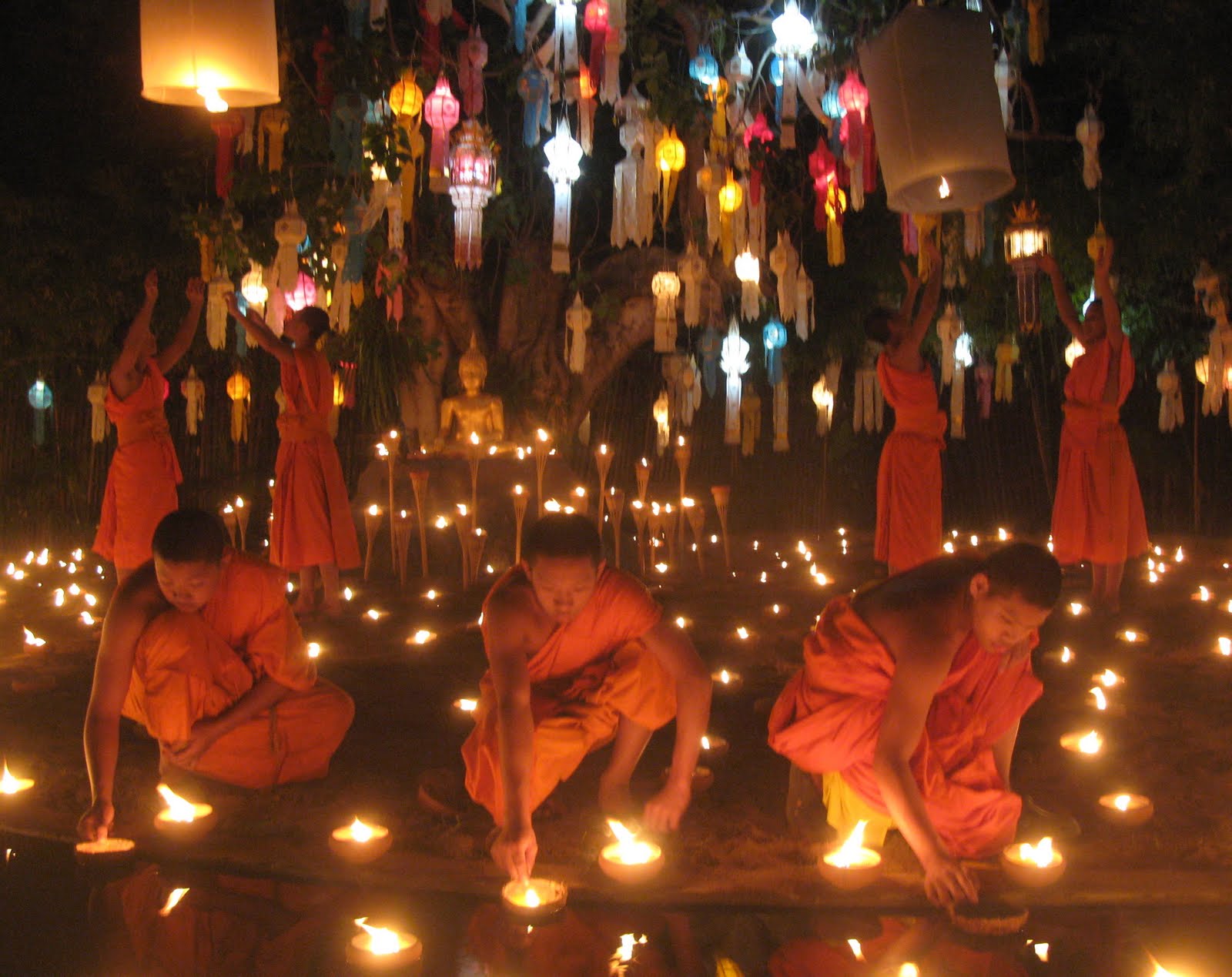
Festival of lights at Wat Pan Tao in Chiangmai.

A ceremonial event to beckon in good wishes for the New Year.


Monday, January 3, 2011

Out and about in Chiangmai

New Years is coming so offerings are being made at temples all over town.

It's not actually snowing in Chiangmai, but hey, what's the harm in getting into the holiday mood. This is actually a promo a local mobile phone company. Mobile phones are very popular in Thailand and practically everyone has one.

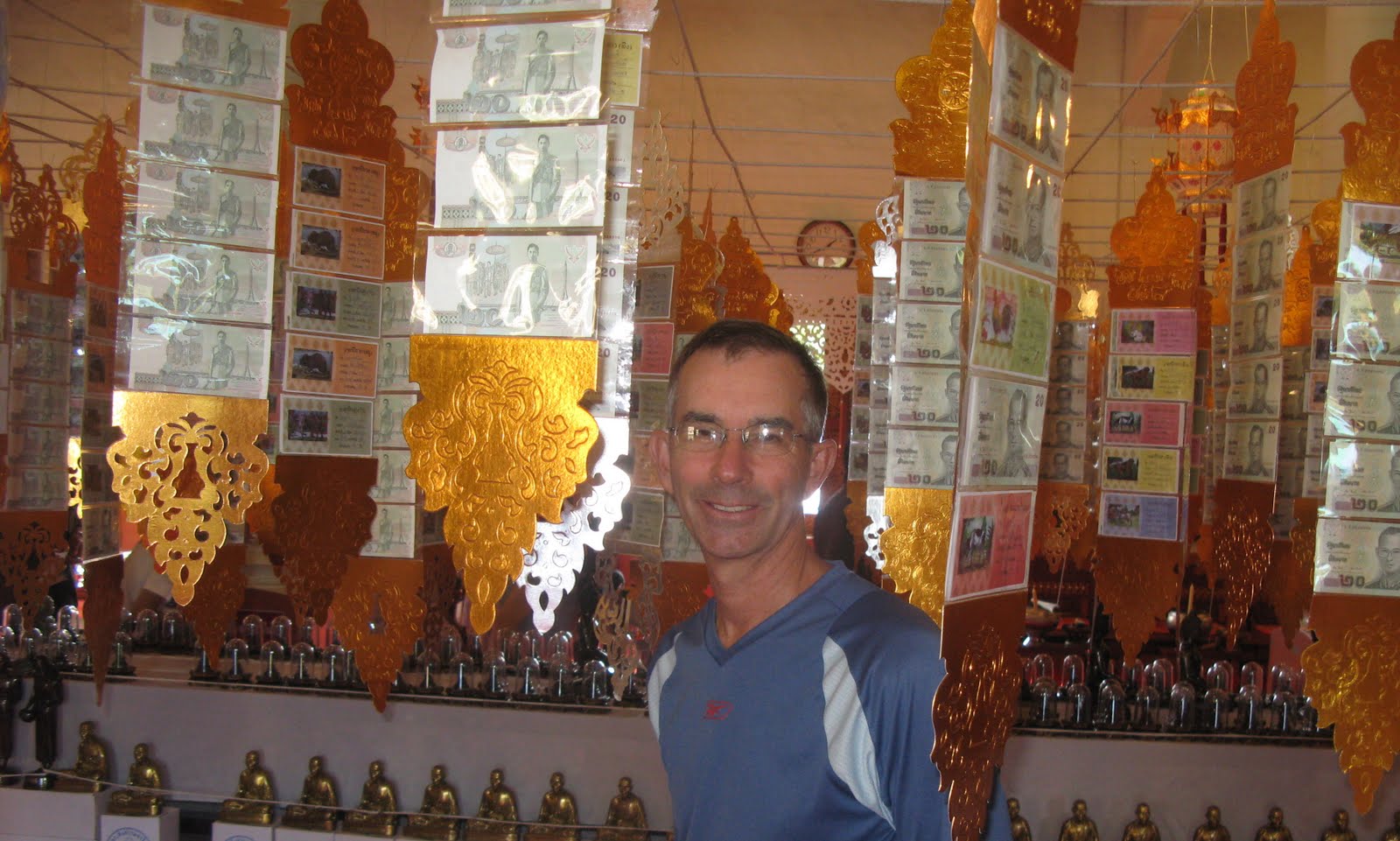
A parade for money offerings. Just another way for people to make their New Year's offerings without actually having to go to the temple.

What's the big deal? It's only a guy dressed up as a girl. So what.

Drag shows are very popular in Thailand, even with the locals.

And quite a beautiful girl at that.

A mobile monk. Loudspeakers blaring down the streets make the announcement that the mobile monk is coming. Twenty baht (75 cents) is all that's asked to receive a blessing.

Probably the closest thing to a holiday tree in Chiangmai.


Temple offerings for the New Year.

Saturday, January 1, 2011

Happy New Year Chiangmai

Happy New Year from Chiangmai. Hope you all have a fantastic 2011.


We, along with everyone else, send our lanterns up into the skies with the hope that the new year will be filled with happiness and good luck.